
B2B Payments: Route Invoices Right. Keep More.
Executive summary
Payment solutions decide whether B2B receivables are a cost center or a competitive edge. Most platforms automate the easy part, the predictable repeating cycle, and leave merchants blind where it counts: when an invoice actually gets charged, whether returned payments flow back into the books, and whether one-off invoices can move without manual work. That gap costs clean books, customer trust and margin.
One structural choice sits underneath it all: a closed billing utility that owns the rules, or an operator-grade platform that hands the rules to you.
TrustPay.us is built on a different model: an enterprise-grade payment platform that gives the operator full command of the payment logic, not a locked utility with preset behavior. Control when invoices are sent and when autopay fires. Run one-off, custom and manually paid invoices alongside recurring cycles without friction. Get ACH returns and failed payments pushed into one unified view automatically. Reach a wider pipeline than standard ACH alone: standard ACH, next-day ACH, same-day and real-time payments, plus remote check deposit.
Then put the economics behind it. Automate invoicing, reminders, payment requests and reconciliation. Route eligible large and recurring payments to ACH at 0.8%, while keeping cards available where they fit. The result: clean accounting data, fewer surprises, faster collection momentum and a lower blended cost of acceptance across the receivables book.
Key points
- Own the payment logic: Control exactly when invoices are sent and when autopay fires, so no customer is charged before the invoice is delivered.
- Handle every invoice type: Recurring cycles, one-off invoices, custom amounts and manual payments, all on the same platform without workarounds.
- Keep the books clean: Payments and ACH returns flow back into one unified view automatically, so finance teams stop chasing what cleared and what failed.
- Reach a wider pipeline: Standard ACH, next-day ACH, same-day and real-time payments, and remote check deposit, beyond standard ACH alone.
- Keep more per invoice: ACH at 0.8% can cost less than accepting every payment by card at 2.9%.
- Lower the blended rate: Every payment routed to the right rail cuts the average cost of acceptance across the whole receivables book.
- Watch the market move: Same Day ACH settled $3.9 trillion in 2025. The per-payment limit rises to $10 million on September 17, 2027.
- Review the whole cost: Businesses processing $1.5 million or more annually can lose $50,000 or more across processing spread, fragmented tools and card fees on payments that belong on ACH.
The Cost of Inertia: Manual AR Keeps Cards in the Lead
A card is easy to accept. A manual accounts receivable process can make it feel like the only practical option.
When a team must create invoices individually, chase overdue balances by hand and match payments line by line, adding another payment method can seem like more work. So large invoices and recurring balances stay on card rails, even when the card fee takes a substantial bite from the payment.
The cost is more than the processing rate. Manual follow-up consumes staff time. Disconnected records complicate reconciliation. Delayed payment requests can slow the path from invoice to cash.
The market is moving toward electronic invoicing and payments as paper checks decline. Yet digitizing payment alone does not solve the problem if invoice delivery, remittance details and cash application remain separate tasks. The Cleveland Fed's research on B2B payment processing describes how those steps connect, and how gaps between payment and remittance data can make reconciliation harder.
Automate AR: Return Time to Your Team
AR automation helps teams move routine collection work forward without turning every invoice into a manual follow-up project.
Use an organized process to:
- Send invoices and payment requests with clear instructions and a direct way to pay.
- Share payment links so customers can complete payment online.
- Schedule recurring billing for repeat balances.
- Automate reminders before and after due dates.
- Accept partial payments when an invoice is being paid in stages.
- Reconcile payments and invoices with less manual matching.
- Review reporting visibility to see what is paid, pending or overdue.
The payoff is practical: fewer routine touches for your team, clearer payment status and less time spent locating or matching transactions. Automated reminders can also help keep invoices in motion. Automation supports the people doing the work; it gives them more time for exceptions, customer relationships and decisions that need human judgment.
Not All AR Automation Is Built the Same
Merchant forums and user communities report recurring complaints about some AR platforms, and they are worth testing for before you commit your receivables to any tool:
- Sync damage in accounting software. Some platforms connected to QuickBooks Online duplicate existing projects or records as separate customer profiles, cluttering clean books and adding cleanup work.
- Autopay that fires before the invoice is sent. If autopay rules charge a customer the moment an invoice is created, before it has been delivered, the business loses control of its own billing sequence and surprises its customers.
- Rigidity on one-off invoices. Platforms built only for predictable repeating cycles can feel restrictive for custom, flexible or manually paid invoices, forcing teams back to manual work for exactly the cases that need judgment.
- Returned payments that fail to sync. ACH returns and failed payments that do not flow back reliably into the accounting system force finance teams to track manually what cleared and what failed, which defeats the point of automation.
The lesson: automation that creates new manual work is not automation. Test any AR platform against your real invoice mix, your accounting software, your autopay rules and your return-handling process before you sign. Ask specifically how returns sync back, how autopay is triggered, and what happens to your existing customer and project records on connection. The difference is structural: a closed utility wraps preset rules around your billing. An operator-grade platform puts you in command of the rules, the timing and the data.

Put Large and Recurring Balances on ACH
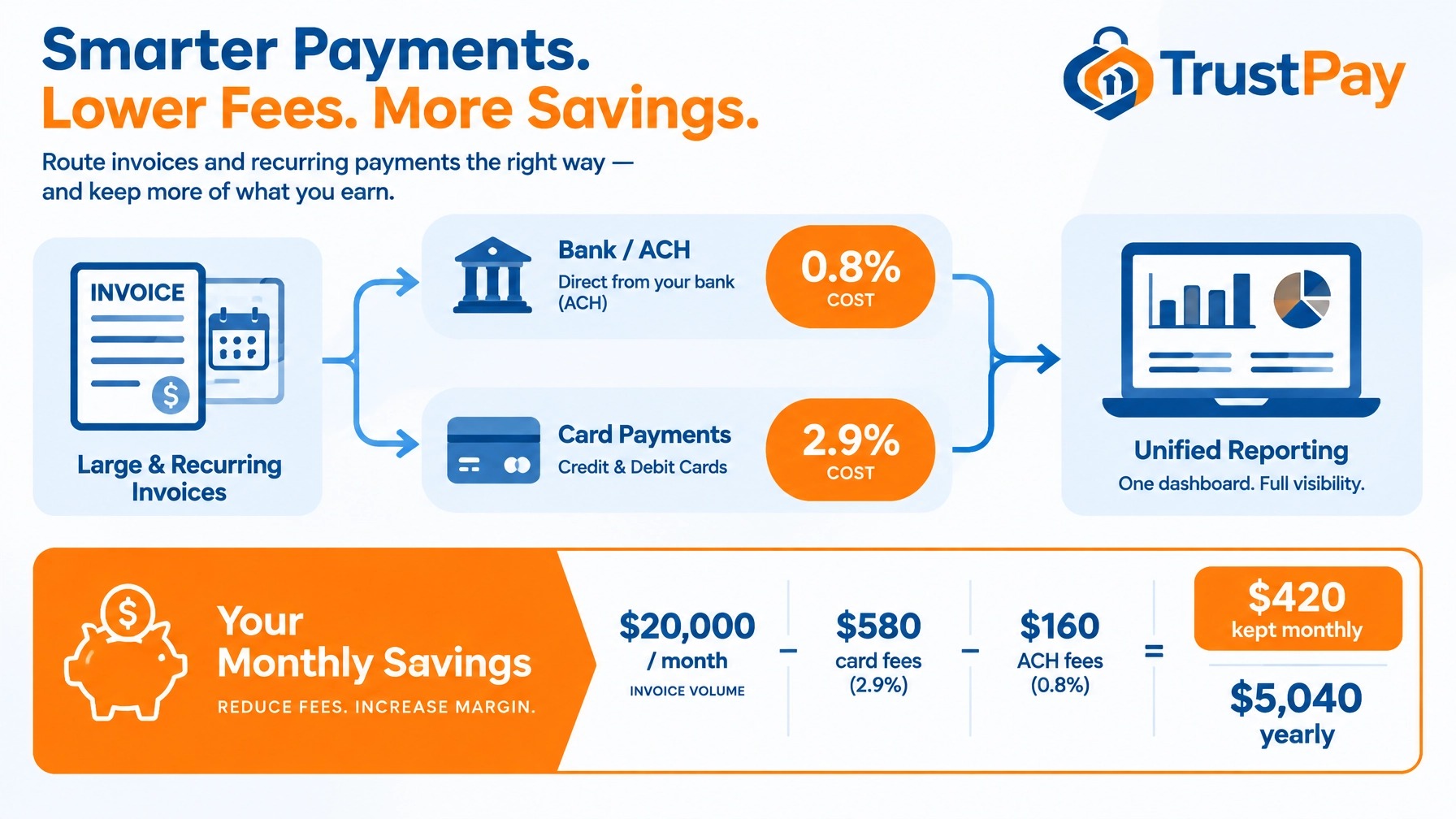
ACH is built for bank-to-bank payments, making it a strong option for eligible B2B invoices, repeat billing and larger balances. At a 0.8% rate, it can reduce the cost of accepting payments that do not need to travel over card rails.
On $20,000 a month, cards at 2.9% cost $580 while TrustPay.us ACH at 0.8% costs $160. That is $420 kept every month and roughly $5,040 a year.
Keep the customer experience clear. Offer ACH for large and recurring invoices, and continue accepting cards where speed, convenience or payer preference make them the right fit. Routing is about giving each payment a sensible path, not forcing every customer into the same method.

Same-Day ACH Is Gaining Momentum
Same-day settlement options are becoming more relevant to business payment workflows. Nacha reported that Same Day ACH settled $3.9 trillion in 2025, with volume growth driven by B2B payments.
Nacha also approved a rule change that raises the Same Day ACH per-payment limit from $1 million to $10 million on September 17, 2027. Review the rule details and confirm payment eligibility and timing with your provider.
That change expands the potential fit for larger business payments. It does not make every payment instant, nor does faster settlement fix a manual AR workflow on its own. Pair the right payment timing with clear invoices, automated follow-up and organized reconciliation to help cash move through the process with less friction.
Blended Rates: Lower the Cost Across the Whole Book
A blended cost of acceptance is the average cost of accepting payments across your full mix. When every invoice goes to the card rail, card costs dominate that average. When eligible payments are routed to lower-cost ACH, the total cost can come down.
Think in transaction types:
- Route large and recurring balances to ACH when eligible.
- Keep cards available for payments where card acceptance makes sense.
- Review the full payment mix in one reporting environment.
The goal is not to eliminate choice. It is to stop paying card rates on payments that could be collected by ACH. Each suitable payment routed to ACH can lower the blended cost across the receivables book.
The math works on a simple mix. Take $20,000 in monthly volume: $12,000 in large invoices routed to ACH at 0.8% costs $96, and $8,000 in card payments at 2.9% costs $232. Total cost: $328, a blended rate of about 1.64% instead of 2.9% on everything. Send the same $20,000 entirely to cards and it costs $580. Routing keeps $252 every month that card-only acceptance hands away, before any rate improvement on the card side.
Q4 Is the Time to Review the Economics
Year-end cash flow pressure makes every avoidable expense more visible. It is also a useful moment to review processing statements, payment tools and upcoming contract auto-renewals. If renewal timing is approaching, compare the cost of staying with the cost of making a planned change before the next term begins.
For businesses processing $1.5 million or more annually, losses can reach $50,000 or more across processing spread, fragmented tools and card fees on payments that belong on ACH. That figure is a reason to audit the whole receivables process, not just one line on a statement.
Measure payment costs alongside staff time, reconciliation effort and the speed of collections. A fee review that ignores manual work can miss part of the financial picture.
The TrustPay.us Difference
TrustPay.us brings AR automation and payment acceptance together on an operator-grade platform, so businesses manage collections with full command instead of preset behavior. Merchants can use invoicing, payment requests, recurring billing, reconciliation and reporting visibility, with ACH at 0.8% for eligible business payments.
That includes the fundamentals the complaints above expose, solved structurally:
- Billing trigger control. You set the automation logic, the billing frequencies and the notification sequences. Invoices charge when you decide, not when a draft exists.
- One-off flexibility built in. On-demand virtual terminal, text-to-pay, custom web forms and one-off smart payment links sit beside recurring billing, so custom and manually paid invoices never bounce back to manual work.
- Unified return management. ACH returns and risk metrics are pushed immediately into a single unified view, so accounting teams see what cleared, what is pending and what failed without chasing records.
- A wider pipeline. Standard ACH, next-day ACH, same-day and real-time payments, and remote check deposit, so each payment moves on the rail and the timing that fits it.
The platform also supports card and cryptocurrency acceptance, virtual terminal processing, payment links and next-day funding. Transparent pricing helps merchants review costs. TrustPay.us supports high-risk business types and provides 24/7 human support.
For agents, ISVs, CPAs, payroll providers and other partners, a well-routed receivables process creates a practical way to help clients examine fees, reduce avoidable manual work and improve payment visibility. Start with the client's invoice mix and collection workflow, then identify where ACH fits.
Run a Fee Audit. Keep More of Every Invoice.
Stop accepting card-sized costs by default. Review your processing fees, identify payments that fit ACH and see where automation can return time to your team.
Run your TrustPay.us Fee Audit
Industry methodology and references
Industry methodology: numerical scenarios are illustrative unless a named source and method are supplied; they are not measured TrustPay customer outcomes. Calculate card cost using the actual invoice value and quoted rate, then include transaction, platform, return, conversion and settlement charges for alternatives. ACH requires authorization and can be returned. Crypto finality is not a guarantee against fraud, refunds or payout delays. Cash discount, dual pricing and surcharging are distinct programs subject to applicable rules. Implementation and savings depend on the business, customer adoption and actual contract.
Which payment workflow fits the industry problem?
Compare the full cost of cards, suitable ACH payments and optional crypto acceptance. Start with the actual fee schedule, customer payment preferences and settlement needs.
Get Your Free Quote →