
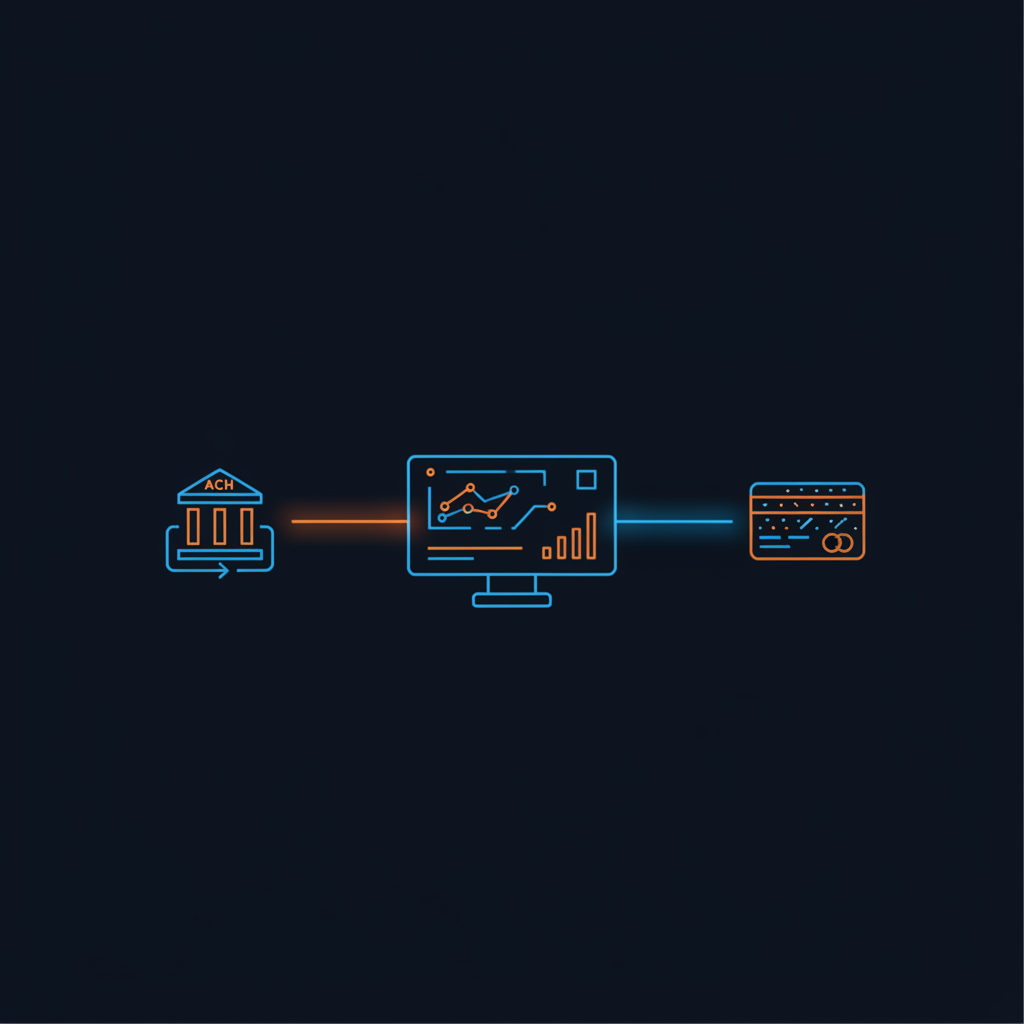
How to Integrate ACH and Credit Card Payments into One Seamless Dashboard
How to Integrate ACH and Credit Card Payments into One Seamless Dashboard
Managing a business in 2026 shouldn't feel like you're a professional plate spinner. If you're currently logging into one portal for your credit card transactions, another for your bank transfers (ACH), and a third to manage your manual invoicing, you aren't just losing time: you're losing money. The modern merchant needs a "command center," a single pane of glass that handles every dollar entering the business.
At TrustPay, we've seen the "Frankenstein" payment systems that many business owners cobble together. It's inefficient, it's prone to human error, and frankly: it's outdated. Integrating ACH and credit card payments into one seamless dashboard isn't just a tech upgrade: it's a strategic move to optimize your cash flow and slash your overhead.
Eliminate the Tab-Toggling: The Power of a Unified Platform
The status quo for most B2B and service-based businesses is fragmented. You accept a credit card for a small retail purchase, but then you send a separate PDF invoice for a large order and hope the client sends a wire or a check. This creates a massive data gap.
When your payments are siloed, your accounting team spends hours on "reconciliation math." They have to match bank deposits to invoice numbers across different platforms. By moving to a unified dashboard, you create a single source of truth. Every transaction, regardless of the "rail" it traveled on, is logged in one spot.
Traditional Process: 5 Hours/Week on Reconciliation vs. TrustPay Solution: 0 Hours (Automated).
Stop Overpaying: The Financial Math of Blended Payments
One of the biggest benefits of a unified dashboard is the ability to steer your customers toward the most cost-effective payment method. If you're processing a $10,000 B2B invoice via a standard credit card, you could be looking at $290 or more in fees. If you process that same transaction via ACH through your integrated dashboard, that fee could drop to a flat rate of less than a dollar.
The Comparison:
- Traditional Card Fees: $10,000 Invoice x 2.9% = $290.00
- TrustPay ACH Solution: $10,000 Invoice x Flat Fee = $0.50
- Immediate Savings: $289.50 per transaction.
By integrating both options into your ACH Payments portal, you give your customers the choice while protecting your margins. You can even set rules within your dashboard to default to ACH for high-ticket invoices, ensuring you never pay a percentage-based fee on a massive sale again.
Accelerate Your A/R: Choice Equals Faster Cash Flow
Speed of service isn't just about how fast you ship a product: it's about how fast the money hits your bank account. When you provide an integrated dashboard with a "Pay Now" link on your invoices, you remove the friction that causes payment delays.
🚀 Reduce Collection Time: Offering both Card and ACH options means customers pay immediately rather than "waiting to get back to the office" to send a check. ✅ Eliminate Manual Entry: Payments made through the dashboard automatically update your ledger. 📈 Track in Real-Time: See exactly who has opened an invoice, who has scheduled an ACH transfer, and who is overdue.
Most businesses find that by offering multiple payment methods on a single invoice, their Day Sales Outstanding (DSO) drops by as much as 30%. When it's easy to pay, people pay faster.
The Technical Blueprint: How to Integrate for Success
You don't need a degree in computer science to get this right. The goal is to move away from standalone terminals and toward an API-driven or software-native approach. Here is how you bridge the gap:
- Centralize Your Gateway: Use a provider like TrustPay that handles both card and bank rails. This ensures that your Solutions are cohesive rather than competitive.
- Enable Tokenization: This is a non-negotiable for security. When a customer enters their bank details or card number, the system replaces that sensitive data with a secure "token." This allows you to charge repeat customers with one click without storing their actual data on your servers.
- Sync with your Accounting Software: Your dashboard should "talk" to your GL (General Ledger). Whether you use QuickBooks, Xero, or a custom ERP, the goal is for the payment to "post" itself the moment it's authorized.
- Implement a Customer Portal: Give your clients a login where they can manage their own payment methods. This "self-service" model reduces the burden on your customer support team and builds trust.
Direct Quote from the Top
As we continue to push the boundaries of what a payment partner should provide, our focus remains on the bottom line of the merchant.
B2B industries face a structural cost problem: a card percentage scales with invoice value, while manual remittance matching adds collection work. Offer authorized ACH for suitable invoices, retain cards where customers need them, and connect invoice references to settlement reporting. Compare the full fee schedule, funds-availability terms and return exposure before changing the payment mix.
Maximize Efficiency: Scannable Features of a Seamless Dashboard
If you're evaluating a new platform, look for these "Must-Have" modules to ensure you're getting a true unified experience:
- 📱 Mobile-Ready Interface: Manage your business from the golf course or the airport. Your dashboard should be as functional on a smartphone as it is on a desktop.
- 🔒 PCI Level 1 Compliance: Ensure your provider handles the heavy lifting of security certifications so you don't have to.
- 📊 Advanced Analytics: You should be able to see your "Effective Rate" (your total cost of processing) across all payment types at a glance.
- 📧 Automated Dunning: The system should automatically email customers when a card is about to expire or an ACH payment fails.
- 💳 Surcharge Capabilities: If you want to accept cards but don't want to pay the fees, your dashboard should allow you to automatically pass those costs to the consumer.
The High Cost of Doing Nothing
Staying with your current, fragmented system is a choice: and it's an expensive one. Between the higher percentage-based fees on large invoices and the administrative "tax" of manual reconciliation, your business is leaking profit every single day.
Imagine a world where you wake up, open one app, and see a unified total of your daily sales: regardless of how they were paid. No spreadsheets. No manual bank lookups. No "did they pay yet?" phone calls. That is the reality of a seamless dashboard integration.
Take Control of Your Payments Today
The transition to a unified platform is faster than most people think. Often, we can have a merchant up and running with a blended ACH and Credit Card suite in just a few business days.
Don't let your payment processing be a hurdle. Turn it into a competitive advantage that fuels your business growth. If you are ready to see how much you can save by switching to a unified dashboard, check out our ROI Calculator Page to see the numbers for yourself.
Ready to simplify? Book a Consultation with our team today and let's build a custom payment strategy that works for you, not against you.
Industry methodology and references
Industry methodology: numerical scenarios are illustrative unless a named source and method are supplied; they are not measured TrustPay customer outcomes. Calculate card cost using the actual invoice value and quoted rate, then include transaction, platform, return, conversion and settlement charges for alternatives. ACH requires authorization and can be returned. Crypto finality is not a guarantee against fraud, refunds or payout delays. Cash discount, dual pricing and surcharging are distinct programs subject to applicable rules. Implementation and savings depend on the business, customer adoption and actual contract.
Visa: card pricing and surcharge rules · Nacha: ACH payments · Nacha: ACH returns and risk
Which payment workflow fits the industry problem?
Compare the full cost of cards, suitable ACH payments and optional crypto acceptance. Start with the actual fee schedule, customer payment preferences and settlement needs.
Get Your Free Quote →