
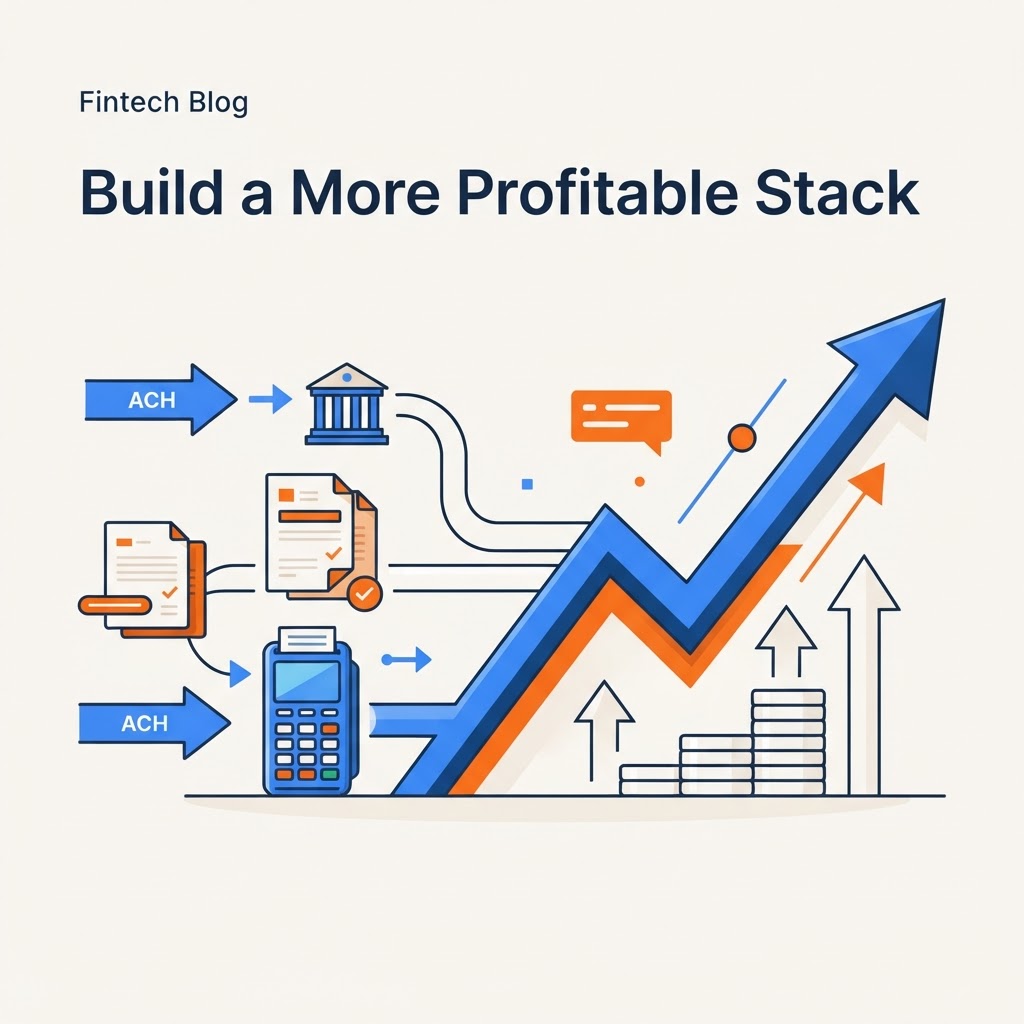
Payment Solutions: Build a More Profitable Stack
Payment Solutions: Build a More Profitable Stack
Payment solutions directly influence your margins, cash flow, labor costs, and revenue retention.
Every payment creates a financial outcome. The payment method affects your cost. The collection process affects your cash flow. The system behind the transaction affects your reporting, reconciliation, and team workload.
A better payment solutions stack connects these moments so your business keeps more of what it earns.
💰 Start with the Money: Lower the Cost of Getting Paid
Traditional card processing can become expensive when every transaction follows the same path.
That approach often sends large invoices, recurring payments, and B2B transactions through card rails even when a lower-cost bank transfer may fit better.
A more profitable stack matches the payment method to the transaction:
| Payment Need | Better-Fit Option | Business Benefit | |---|---|---| | Everyday customer purchases | Credit and debit cards | Fast, familiar acceptance | | Larger invoices | ACH bank transfers | Lower payment costs | | Online purchases | Online checkout and payment links | More convenient collection | | Recurring billing | Automated billing | Fewer manual follow-ups | | In-person sales | POS and modern hardware | Faster checkout and cleaner reporting | | Digital asset payments | Cryptocurrency acceptance | New payment flexibility and settlement options |
The Math on Routing
For example, consider $50,000 in monthly collections:
- All-card at 2.9%: $1,450 in processing cost
- 30% routed through ACH at 0.8%: $1,135 in blended processing cost
- Illustrative monthly difference: $315
- Illustrative annual difference: $3,780
Actual rates and savings depend on your business, transaction mix, risk profile, and pricing agreement. The financial principle remains clear: route appropriate transactions through the most efficient payment method.
🏦 Route Larger Transactions Through ACH
ACH can give merchants a lower-cost collection option for invoices, retainers, deposits, subscriptions, and other larger payments.
A card fee that looks small on a $50 purchase becomes much more significant on a $10,000 or $20,000 invoice.
Use ACH to help:
- Reduce the cost of larger transactions.
- Collect recurring payments from bank accounts.
- Automate payment requests and return handling.
- Improve cash-flow predictability with available next-day funding.
- Reconcile bank transfers alongside card activity.
TrustPay's ACH solution supports payment requests through invoices, links, and virtual terminal workflows. Transactions can appear alongside card and cryptocurrency activity in consolidated reporting.
Bank accounts also do not expire like cards — that can help reduce a common source of recurring payment failures, although returns and authorization risks still require appropriate controls.
ACH is an essential add-on for merchants whose payment mix includes larger invoices, professional services, medical billing, automotive transactions, property management, or B2B collections.
⬡ Automate Invoices and Retain More Finance-Team Time
Unpaid invoices create two costs:
- Delayed cash flow.
- Staff time spent sending reminders, checking payment status, and updating records.
Automated receivables can reduce the manual work surrounding payment collection.
Build a workflow that moves from:
Invoice sent → branded invoice delivered by email, text, or payment link
Payment reminder → scheduled follow-up without repetitive staff effort
Customer authorization → card or ACH payment method selected
Settlement → funds move according to the agreed schedule
Reconciliation → payment status flows into reporting and accounting workflows
This structure helps your team spend less time chasing receivables and more time supporting customers, managing operations, and growing the business.
TrustPay supports invoicing, recurring billing, payment links, virtual terminal payments, scheduled reporting, and integrations with QuickBooks Online and Sage Intacct. These capabilities can reduce duplicate entry and give finance teams a clearer record of what was billed, paid, settled, or returned.
🖥️ Improve POS and Online Acceptance Without Rebuilding Everything
A profitable stack does not require replacing every system at once.
Keep the POS that works. Add ACH for larger payments. Connect automated receivables. Replace outdated hardware only when it limits speed, reporting, or payment acceptance.
This incremental approach reduces disruption and avoids unnecessary:
- Extra contracts.
- Separate support relationships.
- Duplicate data entry.
- Unconnected reporting systems.
- Additional logins for related payment tasks.
When the POS needs improvement, modern software and hardware can connect more of the sales process: order entry, inventory, employee activity, customer payments, digital receipts, online ordering, sales reporting, and customer loyalty.
TrustPay POS supports countertop, handheld, and kiosk options, with cloud-based management, real-time analytics, online ordering, kitchen display integration, and employee controls.
🧡 Use Modern Hardware to Capture More Sales
Outdated hardware can slow checkout and create unnecessary friction for staff and customers.
Modern payment devices support more than a card tap:
- Contactless cards and digital wallets
- Chip and magnetic-stripe cards
- QR payments
- ACH or bank transfer acceptance
- Cryptocurrency payments
- Digital and printed receipts
- Offline transaction workflows where supported
- Tableside, mobile, kiosk, or countertop use
Choose hardware based on your payment environment:
- Retail: countertop POS with scanning and inventory support
- Restaurants: handheld devices, tableside payment, and kitchen integration
- Services: virtual terminal, payment links, and invoice collection
- Events: portable devices for faster mobile acceptance
- Multi-location businesses: centralized cloud reporting and controls
📊 Turn Payment Data Into Operating Control
Payment activity should produce useful financial information, not just a deposit.
A stronger stack gives owners and finance teams visibility into:
- Gross sales
- Payment method mix
- Settlement timing
- ACH returns
- Refunds and discounts
- Employee performance
- Location-level activity
- Online and in-person revenue
- Reconciliation status
- Processing costs
Track which payment methods cost the least. Identify where invoice collection slows down. Compare online and in-person performance. Review settlement timing before making staffing, inventory, or cash-management decisions.
TrustPay's reporting tools are designed to bring payment activity into a more organized view. Integrations with accounting software can further reduce manual reconciliation work.
⬡ Add Cryptocurrency When It Supports Revenue Goals
Cryptocurrency acceptance should be a strategic add-on, not a requirement for every merchant.
For businesses serving customers who hold Bitcoin, USDT, ETH, or other supported digital assets, crypto can expand payment flexibility. TrustPay supports cryptocurrency payments in-store and online, with options that may include instant settlement or automatic conversion to USD.
Potential business benefits include:
- Accept: additional payment preferences at checkout
- Reduce: exposure to traditional card chargebacks on eligible crypto transactions
- Settle: funds quickly according to the selected arrangement
- Serve: customers who actively prefer digital asset payments
- Consolidate: card and crypto activity in related reporting workflows
🔐 Use the TrustPay Difference to Improve Payment Economics
TrustPay focuses on the full payment journey rather than only the few seconds when a transaction is authorized.
Unified Payment Capabilities
Connect cards, ACH, online payments, POS, invoicing, hardware, and cryptocurrency acceptance according to your business needs.
Cash Discount Program
Use eligible cash discount or dual-pricing strategies to present customers with pricing options that account for card-processing costs. This may help qualifying merchants reduce their effective processing expense, potentially reaching zero processing fees on eligible card transactions when structured and disclosed properly. Programs must follow applicable laws, card-network rules, and required customer disclosures.
Fast Funding Options
Select available daily, weekly, monthly, or manual payout schedules based on your cash-flow requirements and agreement.
Better Support
Get access to 24/7 human support through phone, email, and live chat. Payment issues deserve a real response from a real person.
Flexible Adoption
Keep what works. Fix what does not. Add only the payment capabilities that create a measurable business benefit.
✅ Build the Stack Around Your Highest-Value Opportunity
Do not begin with a product list. Begin with the largest source of lost margin or wasted time.
Action plan:
- Review your true effective processing cost.
- Separate large invoices from everyday card transactions.
- Calculate the labor cost of manual receivables and reconciliation.
- Check whether your POS and online checkout support the customer experience you need.
- Evaluate modern hardware for mobile, countertop, kiosk, or tableside acceptance.
- Add cryptocurrency only where customer demand and business economics support it.
- Connect reporting and accounting workflows.
- Keep existing tools that perform well.
- Replace only the systems creating measurable cost, delay, or operational friction.
🚀 Start Your Payment-Cost and Workflow Review
Build a payment stack that lowers costs, accelerates cash flow, reduces AR labor, and gives your team better control over every payment.
TrustPay.us can review your current setup and identify practical opportunities across card-processing costs, ACH eligibility for larger transactions, invoice and receivables automation, POS and online acceptance, hardware needs, settlement schedules, reporting and reconciliation, and cryptocurrency acceptance.
Start with a clear view of the math. Keep what works. Fix what costs you money.
Get your free payment-cost review or contact TrustPay.us to begin.
Industry methodology and references
Industry methodology: numerical scenarios are illustrative unless a named source and method are supplied; they are not measured TrustPay customer outcomes. Calculate card cost using the actual invoice value and quoted rate, then include transaction, platform, return, conversion and settlement charges for alternatives. ACH requires authorization and can be returned. Crypto finality is not a guarantee against fraud, refunds or payout delays. Cash discount, dual pricing and surcharging are distinct programs subject to applicable rules. Implementation and savings depend on the business, customer adoption and actual contract.
Which payment workflow fits the industry problem?
Compare the full cost of cards, suitable ACH payments and optional crypto acceptance. Start with the actual fee schedule, customer payment preferences and settlement needs.
Get Your Free Quote →