
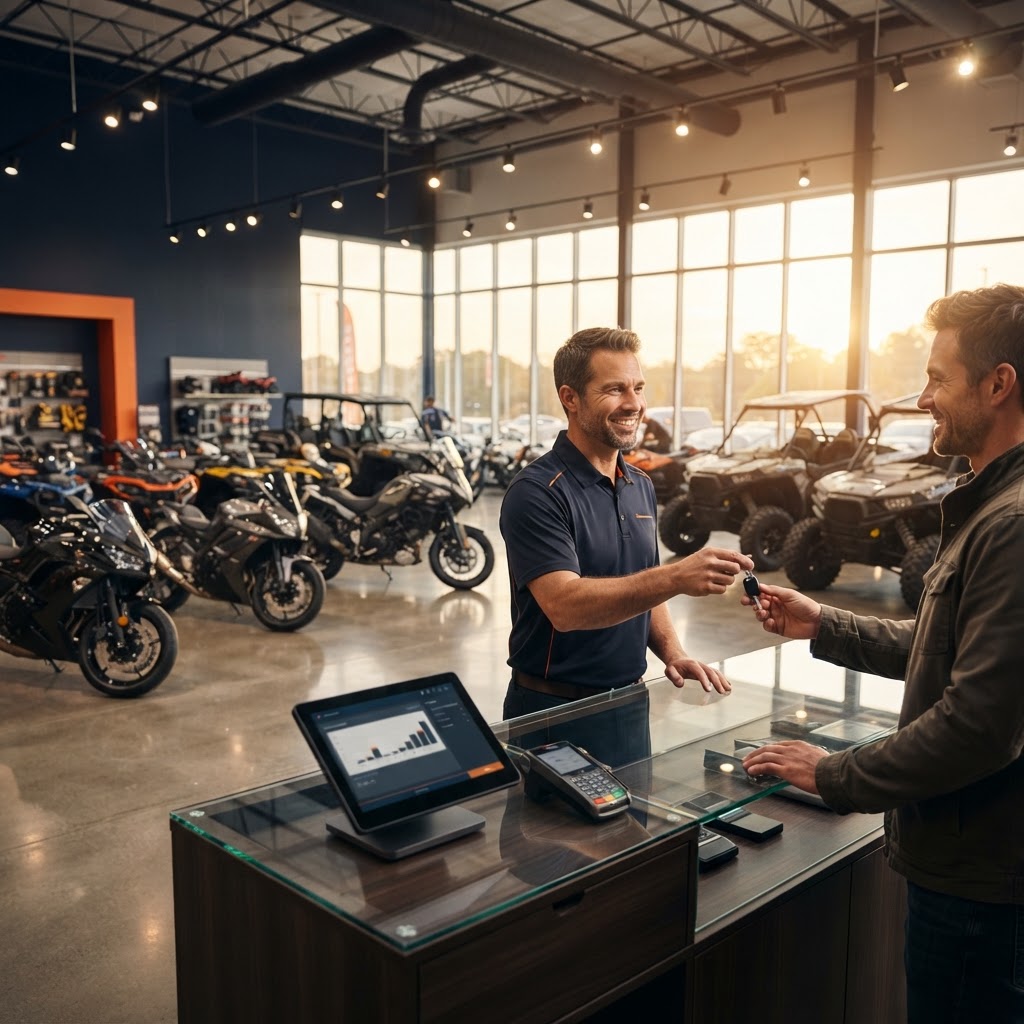
Payment Wars Are Raging. Your Showroom Is the Battlefield.

This article is about payment solutions for powersports and motorsports dealerships: while major POS and payment platforms fight over merchant accounts, hardware, software, and processing, the dealership is the prize and the showroom floor, delivery hand-off, and service counter are where that fight is decided.
Now is the time to evaluate your current payment setup. The close is the moment of truth. Slow, disconnected, fee-heavy workflows can stall delivery, create friction at the counter, and weaken the follow-up sale in parts and service.
Here is the head-scratching question:
What if your payment setup is not supporting the full dealership workflow: just collecting a card at the end?
The distinction matters because the market is changing quickly. Toast, Square, Clover, ISVs, and traditional POS providers are no longer competing only on checkout screens or processing rates. They are competing for the merchant workflow around hardware, software, mobility, reporting, and payment acceptance.
The winning dealership payment setup now connects:
- The showroom floor
- The handheld terminal
- The countertop terminal
- The tablet
- The online checkout
- The delivery hand-off
- The parts and service counter
- The customer receipt
- The business report
- The payment relationship
The terminal still matters. Its role is simply becoming much bigger.
The Close Happens on the Floor
Collect payment where the customer says yes.
A disconnected setup answers one question: Did the payment go through?
A connected dealership payment setup should answer much more:
- Which vehicle, part, or service order was sold?
- Which staff member completed the close?
- Did the down payment post correctly?
- Was the invoice approved and delivered digitally?
- Did the customer receive a receipt or payment link?
- When will funds be available?
- Which payment methods were used?
- What should sales, parts, or service do next?
This is why hardware strategy matters even as cloud software, tablets, kiosks, and SoftPOS expand.
A device is not valuable because it looks modern. It is valuable when it removes steps from the dealership workflow.
The best terminal is the one that helps staff close faster, hand off cleaner, and record the transaction correctly the first time.
The Industry Numbers Confirm the Shift
The latest TSG research shows that POS providers are moving toward connected commerce models:
- 79% of providers offer at least one cloud-hosted POS product.
- Only 3% offer on-premise hosting services.
- 24% now offer SoftPOS, up from 16% in 2025.
- Unified commerce is increasingly presented as the next competitive standard.
TSG describes unified commerce as a ground-up system built around a centralized database. That matters to dealerships because separate systems can create separate records, separate logins, and separate follow-up problems across sales, parts, service, and payouts.
Cloud access is now expected. Mobile acceptance is expanding. But neither trend makes physical hardware irrelevant.
It makes hardware selection more important.
Dealerships need to know whether every device connects to the same deal data, payment record, employee permission, receipt history, and reporting system.
Hardware Still Controls the Delivery Moment
Put payment acceptance where the hand-off happens.
A dealership associate should not walk a customer away from a vehicle delivery to chase a fixed payment station. A showroom team should not slow a close because the payment tool is stuck at one counter. A parts or service advisor should not force a customer to wait while invoice approval and payment happen in separate places.
The right device puts acceptance where the work happens:
Countertop terminals
Use a countertop terminal for:
- Main showroom checkout points
- F&I support desks
- Parts counters
- Service counters
- Reception and back-office payment stations
The countertop device becomes the stable anchor for the dealership. It can support receipts, employee access, product lookup, and daily closeout.
Handheld terminals
Use a handheld terminal for:
- Delivery hand-offs next to the unit
- Showroom floor closes
- Mobile acceptance around the lot
- Events and off-site sales
- Service lane and pickup payments
A handheld device reduces the distance between the customer, the vehicle, and the payment moment. That can mean faster closes, cleaner hand-offs, and less friction during delivery.
Tablets
Use a tablet for:
- Deal review
- Invoice approval
- Product and service lookup
- Parts and service workflow
- Customer management
- Manager approvals
- Reporting and business oversight
A tablet can act as a flexible workstation without forcing every employee to operate from a fixed counter.
The important point is not choosing one device for every situation. It is making sure the devices work together.
The Real Competition Is the Connected Dealership Workflow
Stop comparing terminals by appearance alone.
The market discussion around major providers shows how deeply payment companies are moving into POS operations. The competition is no longer only about processing: it is about owning the merchant relationship through software, onboarding, support, and daily operational workflow.
For dealership operators, the practical question is:
Does your payment setup help your dealership close and follow up, or does it only help customers pay?
A connected system should reduce the distance between:
- A showroom close and delivery
- A delivery and the receipt
- A parts invoice and approval
- A service order and payment
- A transaction and a report
- A payment issue and human support
ISVs Are No Longer Treating Payments as a Back-End Detail
Make payments part of the dealership experience.
Fiserv's 2026 ISV Playbook identifies three priorities for software providers:
- Deliver a unified payment experience across in-person, online, mobile, contactless, QR, and digital wallet channels.
- Add embedded financial tools such as working capital and payouts.
- Improve fraud protection without creating unnecessary checkout friction.
The message is clear: payments are no longer something an ISV can simply connect at the end of development.
Payments influence:
- Product design
- Merchant retention
- Revenue opportunities
- Security responsibilities
- Customer experience
- Support requirements
This also explains why hardware tied to software has become strategically important. A payment device can become the physical entry point to the dealership's entire system.
But that connection must be useful. A branded terminal is not enough if the dealership still needs separate tools for online payments, text-to-pay, large ACH transactions, reports, customer records, and payment reconciliation.
The Dealer Test: Five Questions to Ask Before Choosing a Payment Setup
Review the workflow before reviewing the hardware price.
1. Can the same deal data follow the customer?
Check whether the same transaction data appears across the showroom, handheld device, tablet, online checkout, delivery hand-off, and reporting system.
2. Can staff collect payment where the customer stands?
If employees must return to one fixed station for every payment, the system may be creating unnecessary friction during the close.
3. Can the system handle large ACH and online payments?
Larger-ticket transactions belong on ACH or transparent, cost-efficient rails when appropriate. The setup should also support online payments, text-to-pay, and mobile acceptance at delivery.
4. Can managers see sales, parts, service, and payout detail clearly?
Look for real-time reporting, employee controls, payment visibility, and payout detail across the full dealership operation.
5. Can a real person help when a payment interruption threatens a close?
Automated setup is valuable. Automated support is not always enough. Payment interruptions affect revenue immediately.
The TrustPay Difference: Connect the Dealership Workflow
Add capability without slowing the close.
TrustPay connects payment acceptance with practical dealership workflows through:
- Handheld terminals for delivery hand-offs, showroom closes, and mobile acceptance
- Countertop terminals for stable checkout points across sales, parts, and service
- POS and tablet workflows for invoices, approvals, customers, and reporting
- Online gateway support for remote checkout and e-commerce
- ACH for larger-ticket transactions
- AR automation for cleaner follow-up and payment collection
- Cryptocurrency payments including Bitcoin, USDT, ETH, and more for large purchases
- Cash Discount Program options that may help eligible merchants reduce direct processing costs
- Fast funding schedules based on the merchant's needs
- 24/7 human support by phone, email, and live chat
TrustPay supports card, ACH, cash, and cryptocurrency acceptance through connected business tools. The objective is straightforward: help dealerships process payments without forcing sales, parts, service, and delivery to run through disconnected systems.
Your Showroom May Be More Exposed Than You Think
Treat payment hardware and software as a closing decision.
The market is moving toward software-connected payment environments. Cloud hosting is becoming standard. SoftPOS is expanding. Handheld terminals are entering more workflows. Tablets are becoming additional points of service.
Still, the physical device remains where the customer experience happens.
That is why dealerships should not ask only: "What terminal has the lowest upfront price?"
Ask instead:
- Will this device help us close on the floor?
- Will it make delivery faster?
- Will it keep deal data consistent?
- Will it support ACH, online payments, text-to-pay, and mobile acceptance?
- Will it provide reliable reporting across sales, parts, and service?
- Will it help the dealership grow without forcing a complete replacement?
The right payment solution does not merely authorize a transaction.
It turns the transaction into useful dealership activity.
Evaluate Your Dealership Payment Setup Now
Review your current setup before the next close gets slowed down. Identify the gaps:
- Slow delivery hand-offs
- Separate reporting
- Limited payment methods
- Manual invoice approval
- Weak visibility across sales, parts, and service
- Poor support
- Hardware that does not fit the dealership workflow
Then speak with TrustPay.us about the right payment solution for your dealership.
You may not need to replace what already works. You may need the right handheld terminal, countertop checkout point, tablet workflow, online gateway, ACH setup, AR automation, or payment connection to complete the system.
Sources: TSG 2026 POS trends (unified commerce, SoftPOS, and cloud hosting) · Payments Dive: Toast and Clover competition · Square Handheld product features · Fiserv: 2026 ISV Playbook
Industry methodology and references
Industry methodology: numerical scenarios are illustrative unless a named source and method are supplied; they are not measured TrustPay customer outcomes. Calculate card cost using the actual invoice value and quoted rate, then include transaction, platform, return, conversion and settlement charges for alternatives. ACH requires authorization and can be returned. Crypto finality is not a guarantee against fraud, refunds or payout delays. Cash discount, dual pricing and surcharging are distinct programs subject to applicable rules. Implementation and savings depend on the business, customer adoption and actual contract.
Which payment workflow fits the industry problem?
Compare the full cost of cards, suitable ACH payments and optional crypto acceptance. Start with the actual fee schedule, customer payment preferences and settlement needs.
Get Your Free Quote →