
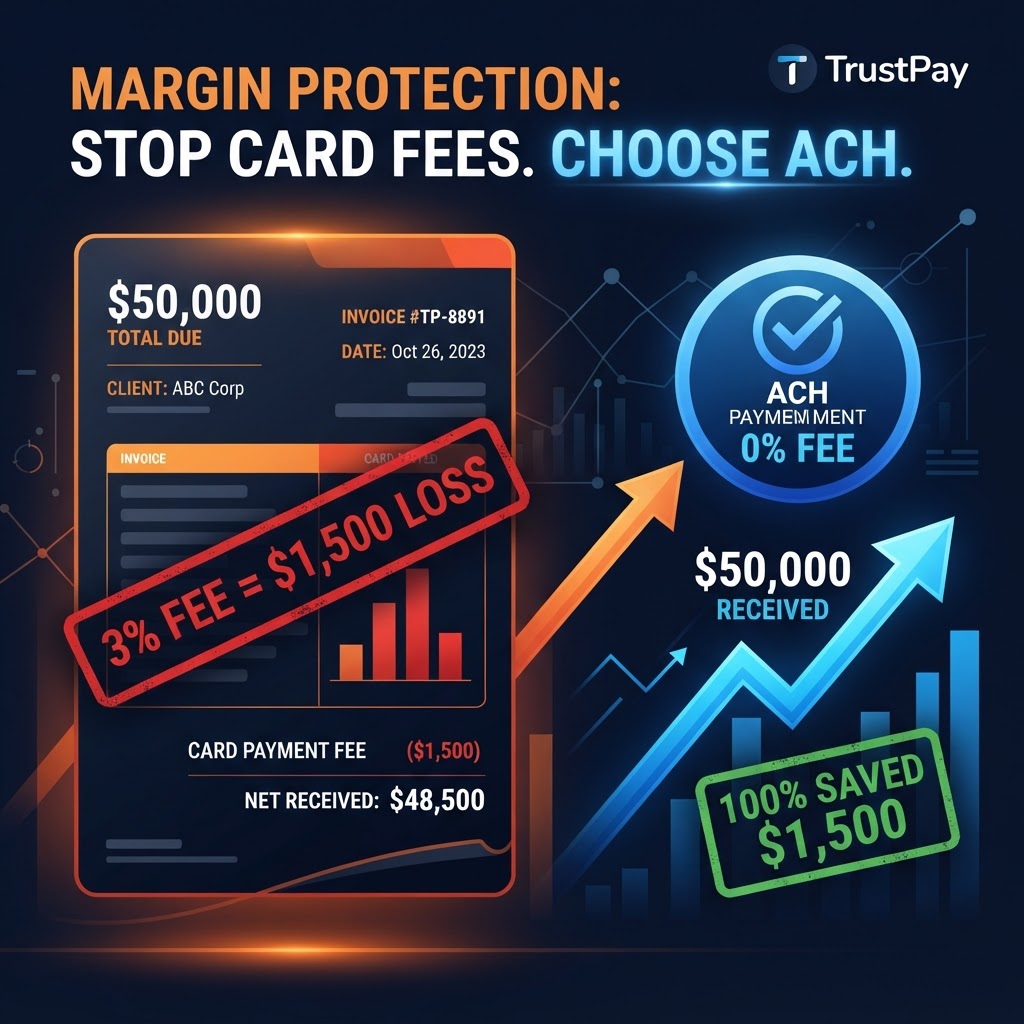
Card vs. ACH on a $50,000 Invoice: An Illustrative Cost Comparison
B2B Ops: Total Margin Control
Every time a high-ticket B2B invoice is paid via credit card: your business loses margin, time, and control. On a single $50,000 transaction, that standard 3% fee is not a routine expense: it is a $1,500 hit to profit plus extra friction for your team to chase approvals, manage retries, and reconcile settlements.
For merchants handling five-figure and six-figure invoices, the old card-payment model creates drag across operations. TrustPay.us gives you the smarter path: route high-value volume to ACH, lock in fixed costs, reduce fraud exposure, and manage vendors, suppliers, and receivables from one unified system.
The Math: Fixed Cost Control Wins
Variable card fees make B2B margins unpredictable. ACH gives you a fixed-cost alternative that protects profit on every large payment.
The Comparison on a $50,000 B2B Invoice:
- Credit Card Fee at 3%: $1,500.00
- ACH Processing Cost: ~$1.00
- Margin Preserved: $1,499.00
- If You Process 20 Similar Invoices: $29,980 kept
Stop accepting variable costs on fixed work. When you move high-value payments to ACH Payments, you turn payment acceptance into an operational advantage.
Slash Friction: Faster B2B Operations
Defaulting to cards for large B2B payments creates extra steps, variable fees, and avoidable margin loss. If your business runs on a 10% margin, a 3% card fee cuts 30% of your profit. That is not efficient. That is operational leakage.
- Reduce Payment Friction: Replace manual card collection with streamlined ACH flows for large invoices.
- Lock In Cost Control: Swap percentage-based fees for fixed, predictable processing costs.
- Automate Billing: Run recurring B2B collections without card expiry issues or repeated customer follow-up.
- Scale Cleanly: Standardize how you collect from vendors, buyers, and supplier networks as volume grows.
B2B industries face a structural cost problem: a card percentage scales with invoice value, while manual remittance matching adds collection work. Offer authorized ACH for suitable invoices, retain cards where customers need them, and connect invoice references to settlement reporting. Compare the full fee schedule, funds-availability terms and return exposure before changing the payment mix.
The TrustPay Difference: Reliability, Visibility, and Scale
TrustPay.us does not force you to choose between flexibility and control: we provide a Unified Platform that handles Credit Cards, Cryptocurrency, and ACH in one dashboard built for B2B operations.
Why Modern Merchants Choose TrustPay.us:
- Control Costs: Compare fixed ACH costs against variable card fees and route payments to protect margin.
- Track Margin Live: Use the dashboard for real-time B2B visibility into payment status, savings, and operational performance.
- Reduce Risk: Use ACH as a secure alternative for card-not-present transactions that carry higher fraud pressure.
- Scale Supplier Networks: Accept and manage payments across vendors and suppliers without stacking disconnected tools.
- Stay Flexible: Use our Virtual Terminal to process payments via phone, tablet, or computer.
- Pay ZERO on Cards: Use the Cash Discount Program to potentially eliminate processing fees on eligible card transactions.
- Get 24/7 Human Support: Reach real people by phone, chat, or email whenever your team needs help.
De-Risk Large Payments
Managing B2B receivables is hard enough without exposing high-value invoices to unnecessary card-not-present risk. Whether you are in Retail, E-Commerce, or B2B Office Services, the goal is the same: keep more, see more, and risk less.
Immediate Actions to Take:
- Audit High-Value Payments: Identify every invoice over $5,000 currently paid by card.
- Move Large Tickets to ACH: Set up TrustPay ACH to reduce variable fees and lower card-not-present exposure.
- Monitor Margin in Real Time: Use the dashboard to track payment status, cost savings, and B2B performance instantly.
- Unify Vendor Payment Flows: Standardize collections across customers, suppliers, and partner networks from one platform.
The Future is Hybrid
The hybrid payment revolution is here. You need a partner that helps you slash friction, control costs, reduce risk, and scale payment operations across every supplier and vendor relationship with ACH, Credit Cards, and Cryptocurrency in one place.
TrustPay.us is that partner. We give B2B teams the tools to automate collections, track margins in real time, and keep a $50,000 invoice as close to $50,000 as possible.
Take Total Control of B2B Margins
Cut payment friction. Lock in fixed ACH costs. Track every dollar live with TrustPay.us.
- REDUCE variable card fees and protect profit on every high-value invoice.
- SWITCH large B2B payments to ACH for secure, low-cost, de-risked processing.
- TRACK real-time margin visibility across invoices, vendors, and supplier networks.
- UNIFY Cards, ACH, and Crypto inside one platform with 24/7 human support.
Or call us directly: (949) 354-3461 | TrustPay.us Contact
Industry methodology and references
Industry methodology: numerical scenarios are illustrative unless a named source and method are supplied; they are not measured TrustPay customer outcomes. Calculate card cost using the actual invoice value and quoted rate, then include transaction, platform, return, conversion and settlement charges for alternatives. ACH requires authorization and can be returned. Crypto finality is not a guarantee against fraud, refunds or payout delays. Cash discount, dual pricing and surcharging are distinct programs subject to applicable rules. Implementation and savings depend on the business, customer adoption and actual contract.
Which payment workflow fits the industry problem?
Compare the full cost of cards, suitable ACH payments and optional crypto acceptance. Start with the actual fee schedule, customer payment preferences and settlement needs.
Get Your Free Quote →